, ,


    black and white dots (like noise on analog TV known as static), each signifying a Facebook profile that pops up when your mouse hovers over it. Created by technologist Natalia Rojas, the site that has managed to display profiles, in chronological order of sign ups, promises not to violate any Facebook privacy rules. And yes, the first dot, is that of Mark Zuckerberg.
    Here's why the project was born: "Because there we are, all mixed up: large families, women wearing burkas, many Leo Messis, people supporting same-sex marriages or r4bia, Chihuahuas, Indian Gods, tourists pushing the leaning Tower of Pisa, selfies, newborns, Ferraris, studio black and white portraits, a lot of weddings but zero divorces, ID photos, faces framed in hearts, best friends, manga characters, politic logos, deep looks, love messages, eyes, memes, smiles, sweet grandparents and some not-yet-censured pictures."
    Find yourself: The site also lets you 'connect' with your own Facebook account to let you find your face # and see where your face appears in the vast density of profiles. Connecting your Facebook account to the app also highlights your friends on the map as larger white dots, letting you see: Who joined first, and who joined last.

    Miami-based Rojas has developed the project using HTML5, Javascript, CSS, jQuery, EaselJS, Ajax, FB API, PHP and MySQL.
    More amazing visualisation tools like Faces of Facebook:
    This is not the first time a developer has tried to visually showcase social profiles and connections on the Internet. 
    LinkedIn's In Maps
    LinkedIn for instance has a map that lets you see your connections called In Maps (http://inmaps.linkedinlabs.com/). The tool displays coloured codes that represent different affiliations or groups from your professional career, such as your previous employer, college classmates, or industries you’ve worked in. You can use the mouse scroll to zoom, click on a connection's name to get more information and label the color-coded clusters to describe your relationships.

    Vizify's Connections for Twitter
    Then there is Vizify Connections (http://vizify.com/connections), that lets you view a visualisation of your Twitter connections. Within seconds, it builds an animated and interactive infographic of your network by creating concentric circles to show how often you've tweeted at/with a person. It categorises people based on their interactions with you. The two broad categories are:
    The Rock: We interact all the time
    The Pal: We interact with some regularity


    MIT's Immersion for Gmail, Yahoo Mail and MS Exchange
    Another interesting tool to view a people-centric history of your email life is MIT's Immersion (https://immersion.media.mit.edu). Immersion uses your email metadata including: 'the From, To, Cc and Timestamp fields of the emails in the account you are signing in with' to show your top collaborators. 

    Foursquare's Time Machine
    Foursquare offers a service called Time Machine (https://foursquare.com/timemachine) that crunches the numbers of all your check-ins to display them on a colourful animated geographic map. It also gives stats on Top Categories of places you visit and a total number of checkins.


    Wolfram Alpha's Facebook Report
    You can also generate a 'Facebook report' (http://www.wolframalpha.com/facebook/) using search engine Wolfram Alpha that has a few visualisations including one that lets you see the structure of your network on the site. However, I couldn't zoom in to my connections using the map and won't recommend this one.

    ,


    Facebook CEO Mark Zuckerberg (R) takes his seat for an onstage interview for with James Bennet (L) of the Atlantic Magazine in Washington, September 18, 2013. REUTERS/Jonathan Ernst
    WASHINGTON | Wed Sep 18, 2013 7:05pm EDT
     
    (Reuters) - Facebook Inc CEO Mark Zuckerberg on Wednesday said revelations about U.S. government surveillance hurt users' trust in Internet companies and that knowing more about the programs would help relieve some of the public concerns.
    In a rare appearance in Washington at an event hosted by the Atlantic magazine, the 29-year-old social media billionaire urged the federal government to tell the general public more about the requests for data it makes to Internet companies.
    Zuckerberg was also holding meetings with members of Congress from both parties to lobby for immigration reform.
    "What I can tell from the data that I see at Facebook is that I think the more transparency and communication the government could do about how they're requesting the data from us, the better everyone would feel about it," he said.
    "From reading in the media, you couldn't get a sense whether the number of requests that the government makes is closer to a thousand or closer to a 100 million. ... I think the more transparency the government has, the better folks would feel."
    Zuckerberg also expressed concerns that the outcry about vast secret spy programs run by the National Security Agency and the U.S. response could alienate other countries and hurt innovation globally. In San Francisco last week, Zuckerberg said the government "blew it" on the spy programs.
    "Response to the NSA issues that have blown up are a big deal for the Internet as a global platform. And some of the government statements I think have been profoundly unhelpful," he said.
    "'Oh, we only spy on non-Americans.' Gee thanks," Zuckerberg said, adding, "We're trying to provide an international service, not get crushed in those places either."
    Earlier this year, Facebook said some 1.1 billion people around the world used its site each month.
    The tech sector has been pushing for more disclosures about government data requests as Internet companies seeks to shake off the concerns about their involvement in vast secret U.S. surveillance programs revealed by former spy contractor Edward Snowden.
    Earlier this month, Facebook joined Yahoo! Inc, Google Inc and Microsoft Corp in asking the Foreign Intelligence Surveillance Court for freedom to disclose aggregate data about the orders and requests for information they receive under the Foreign Intelligence Surveillance Act.
    On Wednesday, Zuckerberg said the revelations about U.S. online surveillance had a much bigger impact on users' trust in Facebook than any criticisms related to the company's own privacy policies.
    PRIORITY ON IMMIGRATION
    The issue that brought California-based Zuckerberg to Washington was his push for immigration reform, which has prompted him to wade deep into political waters.
    This year, he founded an advocacy group, FWD.us, that lobbies for a comprehensive immigration reform, promoting the concept of building a "knowledge economy." The group has come under fire for ads that backed pro-immigration lawmakers on issues unrelated to immigration, such as oil drilling.
    "We just want to be there to help support folks who are going to have to take challenging positions on something that's going to be controversial but they ultimately believe is the right thing," Zuckerberg said.
    He was scheduled for sitdowns on Thursday with Republican House Speaker John Boehner and Democratic House Leader Nancy Pelosi as the House of Representatives poses an uphill battle for the immigration legislation, which already has been passed by the Senate.
    Zuckerburg, who ditched his signature hooded sweatshirt and blue jeans in favor of a dark suit and tie on Wednesday as he made his way through the hallways of Congress, said he was optimistic the legislation's chances.
    (Reporting by Alina Selyukh; additional reporting by Rachelle Younglai; editing by Ros Krasny and Leslie Adler)

    ,


     Facebook page
    Spamming on Facebook could earn those posting the links around $200m annually. Photograph: Thierry Roge/Reuters
     
     
    Bitly spam stats If spammers use bit.ly, it is possible to track how many clickthroughs there have been for a link Spam page on Facebook Spammers posting links on Facebook fan pages to send people to third-party scam sites are earning $200m every year, according to calculations by a team of Italian security researchers who have investigated hundreds of thousands of posts on the social network.
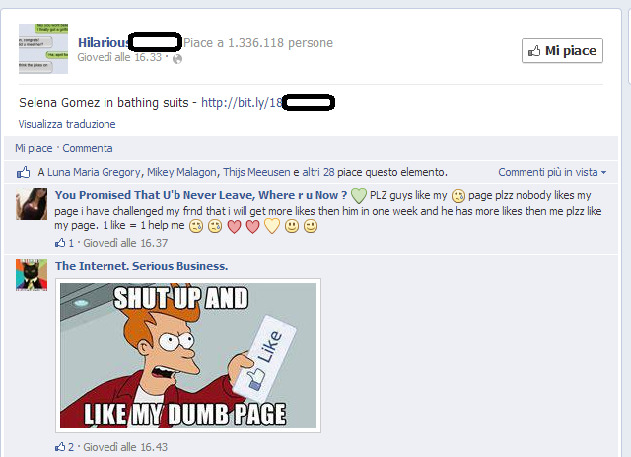
    Andrea Stroppa and Carlo De Micheli, the leaders of the group, analysed pages across the network, and identified spam through the use of phrases such as "Hey click here for a free iPhone" followed by links to sites outside the network.
    They also discovered sites where spammers offer to set up fake fan pages in order to tempt Facebook users to click on links.
    A page with spam links on Facebook
    The postings breach Facebook's terms of service, which says that "third-party advertisements on [fan] Pages are prohibited without our prior permission."

    But trying to catch and get rid of the spammers is a growing problem for Facebook. The revenue that the spammers - and those running the sites linked to - do not form part of Facebook's revenue, but instead piggyback on the success of the social network, which now has more than a billion users worldwide.
    The URLs to the outside sites have their destination hidden by using legitimate link-shortening services such as Tinyurl.com or bit.ly. That also makes it possible for researchers to track the ultimate destination - and figure out how many people click on the link.

    About 9% of the pages that users were directed to by spammers instead use Google's AdSense - meaning that Google inadvertently gets a cut from the money being made by the buyers of spam services.

    Pay per post

    "The spam posters get paid an average of $13 per post, for pages that have around 30,000 fans, up to an average of $58 to post on pages with more than 100,000 fans," De Micheli told the Guardian. "If we consider these two as extremes, the pages we analysed generate a revenue of 18,000 posts per day, times the revenue per post - ranging from $13 to $58 - 365 days a year."
    That gives a range for the spammers' earnings of between $87m and $390m - but when they took into account the number of fans of the pages, the weighted average was just over $200m annually.
    Often the spammers begin by setting up their own "fan pages" and attract human users to them - and then once they have enough Likes on the page they can begin selling links on it to third parties.
    Stroppa and De Micheli found 20 key sites where spammers congregated offering "black marketing" in which they would contract to post spam links in return for cash.
    But the spammers argue that they are helping Facebook. One told the researchers over Skype: "Facebook doesn't ban us, simply because we generate the content on Facebook itself. Everyday I materialize funny, and interesting content full of phrases and so forth that is shared and liked by thousands of users. Without the fan pages Facebook would be an empty place. Tell me how many links do you see shared by your friends on your timeline everyday? You see - the answer is simple."
    But Stroppa and De Micheli counter that the spammer's motive is pure financial self-interest: "For people involved in this business the sole reason to continue is for the profit. We even found somebody who was selling a page dedicated to the memory of the victims of the Boston terrorist attack for $1,000."
    In April, the Italian team uncovered the multimillion-pound business of selling fake Twitter followers, estimating then that as many as 20m were created by spammers and so fake. There, they calculated that Twitter followers were sold in packages - ranging from $1 for 1,000 extra followers, up to $1,000 for a million. They reckoned that made it a business worth between $40m and $360m.

    Long term business

    In looking into Facebook spam, the researchers found posts offering to sell spam links on Facebook fan pages dating back to 2010. But on the present-day forums, they found spammers' prices for posting to pages which already had more than 30,000 "Likes" - and so would be likely to show up in peoples' News feeds, or be regularly visited - varied from $8 to $20. For pages with over 100,000 Likes, the prices ranged from $35 to $100.
    They also uncovered a network of 30,000 pages involved in posting spam to Facebook.
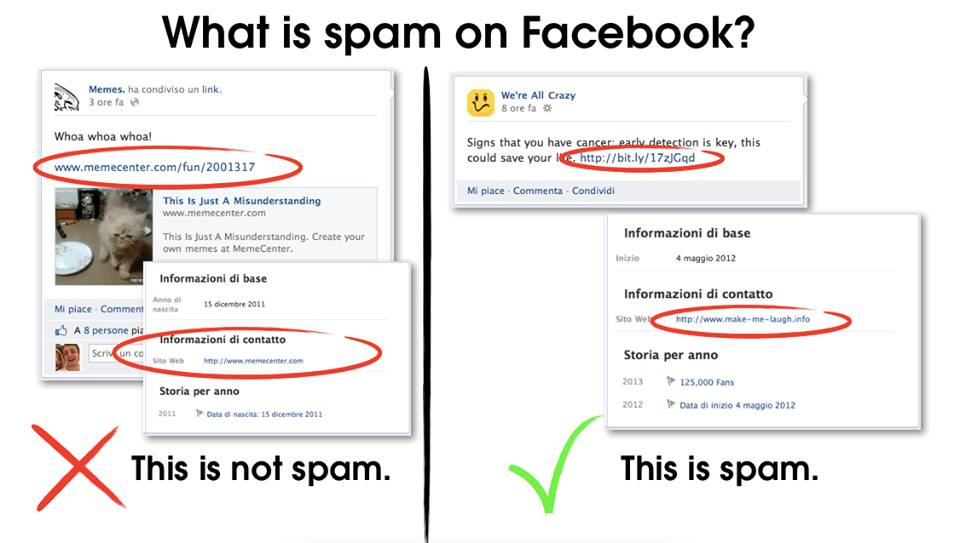
    What is spam on Facebook What is spam on Facebook? Italian researchers offer their guidance
    "Third parties pay spammers to post their links on Facebook pages, to reach the largest amount of users possible," said De Micheli. For the financial model to work, the third parties must be accruing benefits even greater than they are paying the spammers - though it is impossible to know what their rate of return might be.

    "We notice that it is rather common for the landing page [from a link] to be a product on an e-commerce site made to monetise quickly rather than to generate traffic on a home page," De Micheli said. "Links to YouTube can be used to generate views, and so money - view generation on YouTube is a fast-growing market." YouTube offers revenue-sharing arrangements with a number of users.
    Another outside site identified by the researchers promises that some people who post affiliate links - which pay an intermediary small amounts for clickthroughs to the main site - are getting paid "thousands of dollars per day".
    According to their analysis, around one in eight of the pages they looked at was actually harbouring spam links.

    Facebook action

    Facebook takes action against spam pages and posts where they are reported by users, but the sheer volume of spam postings could overwhelm its checkers' ability to crack down on spam.
    A Facebook spokesperson said: "Protecting the people who use Facebook is a top priority for us, and we have developed a number of automated systems to identify potentially harmful links and stop them from spreading. Those systems quickly spotted these links, and we are working to clear them from the site now.
    "In the meantime, we have been blocking people from clicking through the links and have reported the bad browser extensions to the appropriate parties. We believe only a small percentage of our users were affected by this issue, and we are currently working with them to ensure that they've removed the bad browser extension. We will keep improving our systems to ensure that people continue to have a safe experience on Facebook."


Top